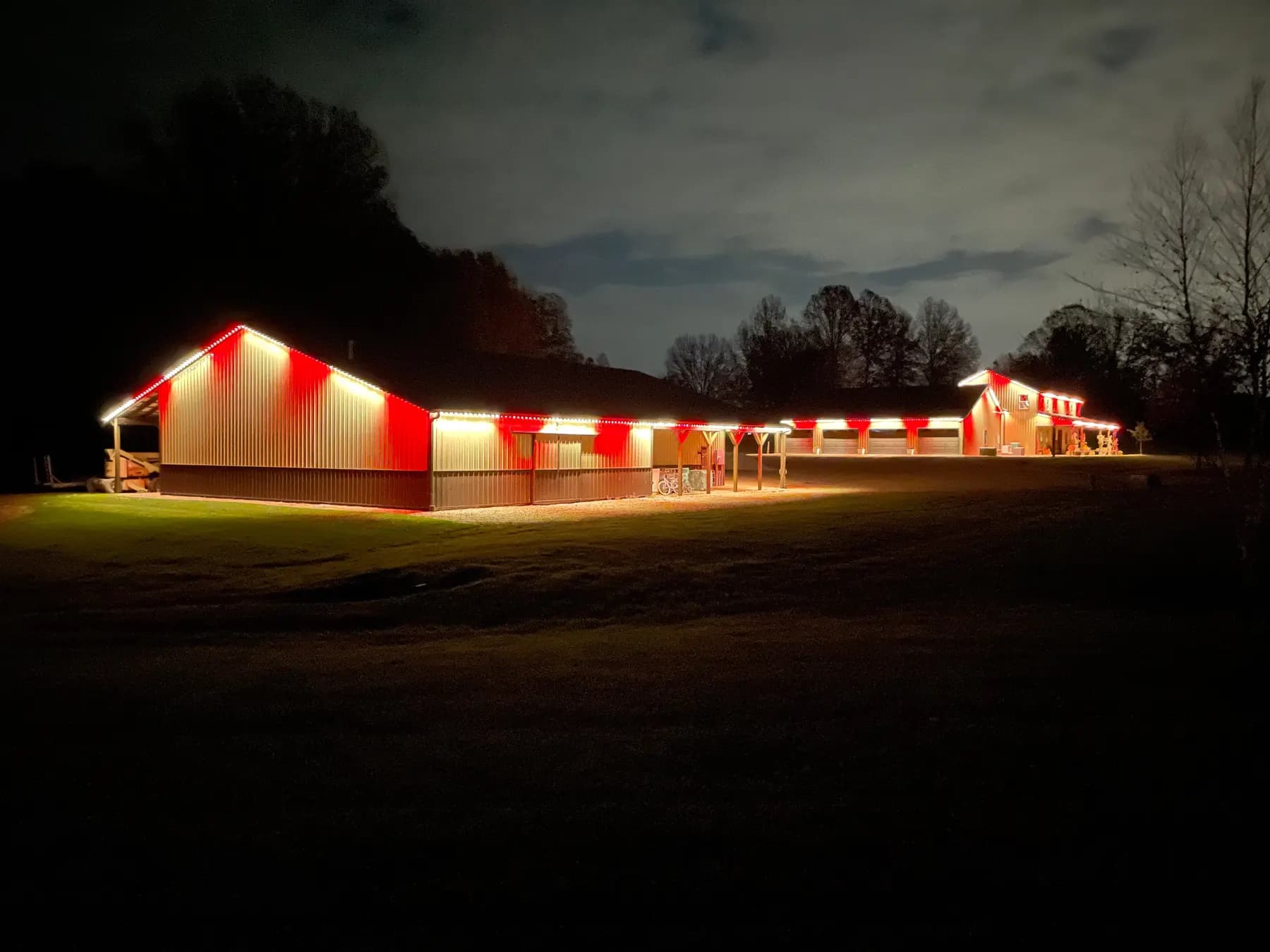
Guides/Guides·8 min read·Updated September 4, 2026
Permanent LED soffit lighting is not just a residential upgrade. Storefronts, medical buildings, restaurants and plazas use the same track-and-puck system to hold brand colours year-round with none of the labour cost of seasonal lights.
Key takeaways
- 1Commercial buildings use the same 12V RGBW puck-and-track system as residential installs, just scaled to longer runs and larger facades.
- 2Brand colours can be locked to a saved preset and scheduled, so the building displays the same colour every night without staff needing to do anything.
- 3Permanent lighting eliminates the recurring seasonal labour cost of hanging and removing string lights for holidays, sales events or grand openings.
- 4CSA Class 2 low-voltage components plug into standard GFCI-protected outlets, which keeps commercial installs simple compared to line-voltage signage lighting.
- 5Our crew installs commercial buildings across London, Woodstock, Kitchener, Waterloo, Cambridge, Guelph, Stratford and Ingersoll; larger facades typically combine multiple kit lengths.
Most people first encounter permanent LED soffit lighting on a house, but the same system scales cleanly to commercial buildings, and for a different set of reasons. A homeowner wants a cleaner-looking holiday display without a ladder every December. A business owner wants a facade that reliably shows brand colours, marks a grand opening, or lights a storefront evenly every night without paying a crew to climb a ladder four times a year. The hardware is identical, but how a commercial building uses it is worth understanding on its own terms.
Why commercial buildings choose permanent over seasonal
Seasonal lighting on a commercial building is a recurring line item, not a one-time purchase. Someone has to install string lights before a holiday season or event, someone has to take them down afterward, and both trips usually involve a lift or scaffolding on anything larger than a single-storey storefront. Bulbs fail mid-season and go unnoticed until a customer mentions it. None of that changes the fact that the lighting only exists for a few weeks a year, while the building sits dark or unlit the rest of the time.
A permanent track system flips that arithmetic. The install happens once, the track and pucks are rated for 50,000 hours and tested to -40°C, and the lighting is available every night of the year, not just during a scheduled campaign. A restaurant can run warm white for regular service, switch to a specific colour for a sponsored event, and return to warm white the next morning, all without anyone touching a ladder. Over a few years, eliminating two seasonal install-and-removal cycles a year on a commercial building often costs less than the recurring labour it replaces.
Brand colour and consistency
For any business with a recognizable brand colour, a permanent RGBW system means that colour can live on the building every single night, not just during a planned lighting event. The WLED-based WiFi controller included in every kit supports saved colour presets, so a facilities manager or franchise owner can lock in an exact brand colour once and have every location run it identically, night after night, without relying on someone to remember a manual setting. Multi-location businesses in particular benefit from this consistency: a customer driving past three locations in different cities sees the same colour on all three, which is a level of brand control seasonal string lights simply cannot offer.
Common commercial use cases
- Retail storefronts running a brand colour nightly, with a schedule change for sale events or holidays.
- Restaurants and hospitality venues using warm white for ambience with occasional colour changes for private events.
- Medical and professional buildings using a clean, consistent white outline for visibility and a professional appearance after dark.
- Strip plazas and multi-tenant buildings coordinating one lighting scheme across several storefronts under a single property management program.
- New locations using a scheduled colour change for a grand opening, then reverting to standard branding afterward.
Scheduling and control at scale
The same WiFi controller used on a residential install handles scheduling for a commercial building: set the lighting to switch on at dusk and off at a set time, or run a specific colour on specific nights, without a staff member touching a switch. For a business with existing hours-based signage lighting, permanent LED track can be scheduled on the same rhythm, coming on with the storefront lights and off after close. Larger commercial properties with several buildings under one management group typically standardize on the same controller setup across every location so the schedule, colours and any future adjustments stay identical across the portfolio.
Sizing a commercial facade
Residential kits are sized from 50 to 250 linear feet, and a single-storey storefront often fits within that range on its own. Larger commercial buildings, strip plazas and multi-tenant facades commonly exceed any single kit length and are built by combining multiple kits or extension runs, planned around the building's actual soffit perimeter rather than a fixed package size. This is where a site visit matters more for commercial work than residential: plaza facades often have multiple roof heights, mixed soffit materials between original construction and later additions, and electrical panel locations that are not always convenient to the lighting run. Power injection and data amplification, which keep long runs evenly lit and responsive, become standard planning items rather than edge cases once a facade run stretches past a single kit length.
Maintenance and reliability for a business
A commercial building cannot afford a dark or half-lit facade any more than it can afford a burnt-out sign. The pucks used across every Illumi Track Lights kit are IP68-rated, sealed against moisture and dust, and tested to -40°C, so they are built for a building that stays lit through a Southwestern Ontario winter without seasonal removal to protect them. The 5-year parts warranty on the components gives a business a defined support window, and because the whole system is 12V low voltage, a burnt-out puck or damaged section of track is a straightforward parallel-wired replacement rather than a full sign or fixture swap.
Installed cost for commercial projects
Every commercial project is different in scope, so an exact quote depends on the building's actual perimeter, soffit material and access requirements, but the same underlying kit pricing applies as the residential side: 50 ft runs start at $1,265, scaling up to $3,157 for a 250 ft kit, with combined and extended runs priced from there for larger facades. Where our own crew installs the project, professional pricing for those same kit lengths runs from roughly $1,665 to $1,998 installed at 50 ft up to $4,157 to $4,988 installed at 250 ft, which is meaningfully below the $25 to $40 per linear foot that national commercial lighting installers typically charge for comparable work. For a multi-building property, that per-foot gap compounds quickly.
Property managers and multi-tenant plazas
Strip plazas and mixed-use buildings bring a coordination problem that a single-tenant storefront never has to solve: several businesses, each with its own signage and hours, sharing one continuous soffit line. Left uncoordinated, that often results in a patchwork of mismatched seasonal lighting where some units decorate and others do not, and the overall building reads as inconsistent no matter how good any individual tenant's effort is. A permanent system installed at the property level solves this by treating the whole facade as one lighting asset rather than a collection of individual tenant decisions. Property management can standardize the base colour and schedule across every unit, while still allowing an individual tenant's section to shift colour for their own promotion without disrupting the rest of the run, since each zone can be wired and controlled independently.
This also simplifies the ongoing relationship between a property manager and its tenants. Instead of negotiating who is responsible for hanging and removing seasonal lights above each unit, or dealing with the visual inconsistency when one tenant participates and a neighbour does not, the lighting becomes a shared building system that management controls and maintains once. New tenants moving into a unit inherit a facade that already looks finished, rather than an empty stretch of dark soffit until they get around to decorating it themselves.
Planning around signage, awnings and mixed facades
Commercial facades are rarely as uniform as a house roofline. Storefronts routinely combine illuminated signage, awnings, varying soffit heights between units, and sometimes a mix of soffit materials where a plaza has been renovated or expanded over the years in phases. None of this rules out permanent track lighting, but it does mean a commercial layout benefits from being planned as a full system rather than treated as a repeatable residential kit applied unit by unit. Track can be run behind or alongside existing signage without interfering with it, routed around awning mounting points, and split into independently controlled zones so a taller anchor unit and a lower flanking storefront can each look correctly proportioned rather than uniformly bright regardless of scale.
For a property considering a full-facade upgrade, this planning step is usually where our installation team adds the most value over a self-install approach: walking the building, noting where signage, awnings and soffit transitions fall, and mapping zones and power feeds before any track goes up, rather than discovering a conflict partway through the install.
DIY, hybrid or full install
Not every commercial project needs a full-service install. A single-storey storefront with straightforward soffit access is well within reach for a maintenance team working from one of our DIY kits (/diy-kits), and the parts catalogue on our shop page (/shop) covers everything needed to extend a run or add a section later as a business grows. For plazas, multi-storey facades, or any project involving ladder work above what an in-house team is equipped for, our professional installation (/installation) covers London, Woodstock, Kitchener, Waterloo, Cambridge, Guelph, Stratford and Ingersoll, and we handle the layout planning, power injection and mounting so the finished facade lights evenly from the first night. Whichever route fits the project, permanent lighting turns a building's exterior into a brand asset that works every night of the year instead of a few weeks of it.
Frequently asked questions
Is permanent LED lighting suitable for commercial buildings, not just houses?
Yes. The same 12V RGBW track-and-puck system used on residential soffits scales to storefronts, restaurants, medical buildings and plazas. Larger facades typically combine multiple kit lengths or extended runs to cover the full building perimeter.
Can I lock a permanent light system to my exact brand colour?
Yes. The WLED-based WiFi controller supports saved colour presets, so a specific brand colour can be set once and run identically every night across one location or many, without staff adjusting anything manually.
How much does permanent lighting cost for a commercial building?
Base kit pricing runs from $1,265 for a 50 ft kit up to $3,157 for a 250 ft kit, with larger facades combining multiple kits. Professional installation for the same lengths runs roughly $1,665 to $4,988 depending on footage, well under the $25-40 per linear foot national installers typically charge.
Does commercial installation require special electrical permitting?
The system is CSA Class 2 low voltage and plugs into a standard GFCI-protected outlet, which generally avoids the additional line-voltage electrical work and permitting associated with traditional signage or accent lighting installs.
Can permanent lighting replace seasonal holiday or event lighting on a storefront?
Yes. The controller can schedule colour changes for holidays, sale events or grand openings and revert to standard branding afterward, eliminating the recurring labour cost of installing and removing seasonal string lights.
Do you install commercial permanent lighting outside of London, Ontario?
Our crew installs commercial and residential projects across London, Woodstock, Kitchener, Waterloo, Cambridge, Guelph, Stratford and Ingersoll. Larger or multi-building commercial projects typically start with a site visit to plan the run and power layout.
Kit or installed
Everything in this guide ships from London, Ontario.
Complete 12V soffit track kits from $1,265, every part sold separately, and professional installation across Southwestern Ontario.
Keep reading
Guides · 9 min
Permanent Outdoor Lights in Canada: The Complete 2026 Guide
Everything Canadian homeowners need to know about permanent outdoor LED lighting in 2026 - how it works, the three quality tiers, real cost per foot, winter durability, and whether to DIY or hire a pro.
Guides · 8 min
Do Permanent Lights Survive Canadian Winters? A -40 °C Durability Guide
The number-one question Canadian homeowners ask before buying permanent outdoor lighting: will it survive winter? Here is an honest, technical answer covering waterproofing, temperature ratings, snow, ice and why build quality matters more than the sales pitch.
Guides · 7 min
HOA, Condo and Bylaw Rules for Permanent Lights in Ontario
Permanent LED soffit lighting is a low-voltage, unobtrusive fixture, but that does not mean every property is free to install it without checking first. Here is what to look for in condo, HOA and municipal rules before you commit.