Guides/Guides·9 min read·Updated August 28, 2026
Everything Canadian homeowners need to know about permanent outdoor LED lighting in 2026 - how it works, the three quality tiers, real cost per foot, winter durability, and whether to DIY or hire a pro.
Key takeaways
- 1Permanent outdoor lights are 12V RGBW LED pucks mounted inside an aluminum track tucked under your soffit - installed once, controlled year-round from your phone.
- 2There are three real tiers: budget DIY strip lights, consumer-grade track systems, and professional-grade track. Only the last is built for Canadian winters.
- 3Expect roughly $18-$45 CAD per linear foot for a quality DIY kit, and about $30-$60 per foot installed by a professional.
- 4Look for a genuine 5-year warranty, an IP65+ rating, and a WiFi app with real scheduling - not a Bluetooth-only remote.
- 5A confident DIYer can install a kit in a weekend; if you would rather not be on a ladder, professional installation is available across Southwestern Ontario.
Permanent outdoor lighting has quietly become one of the most popular home upgrades in Canada - and for good reason. Instead of climbing a ladder every November to staple up seasonal lights (and again in January to take them down), you install one discreet track once and control everything from an app: warm white for everyday curb appeal, red and green for the holidays, orange for Halloween, or off entirely. This guide is written for Canadian homeowners who want the honest version - how the technology actually works, what separates a good system from a disappointing one, what it really costs, and how it holds up to our winters.
What are permanent outdoor lights?
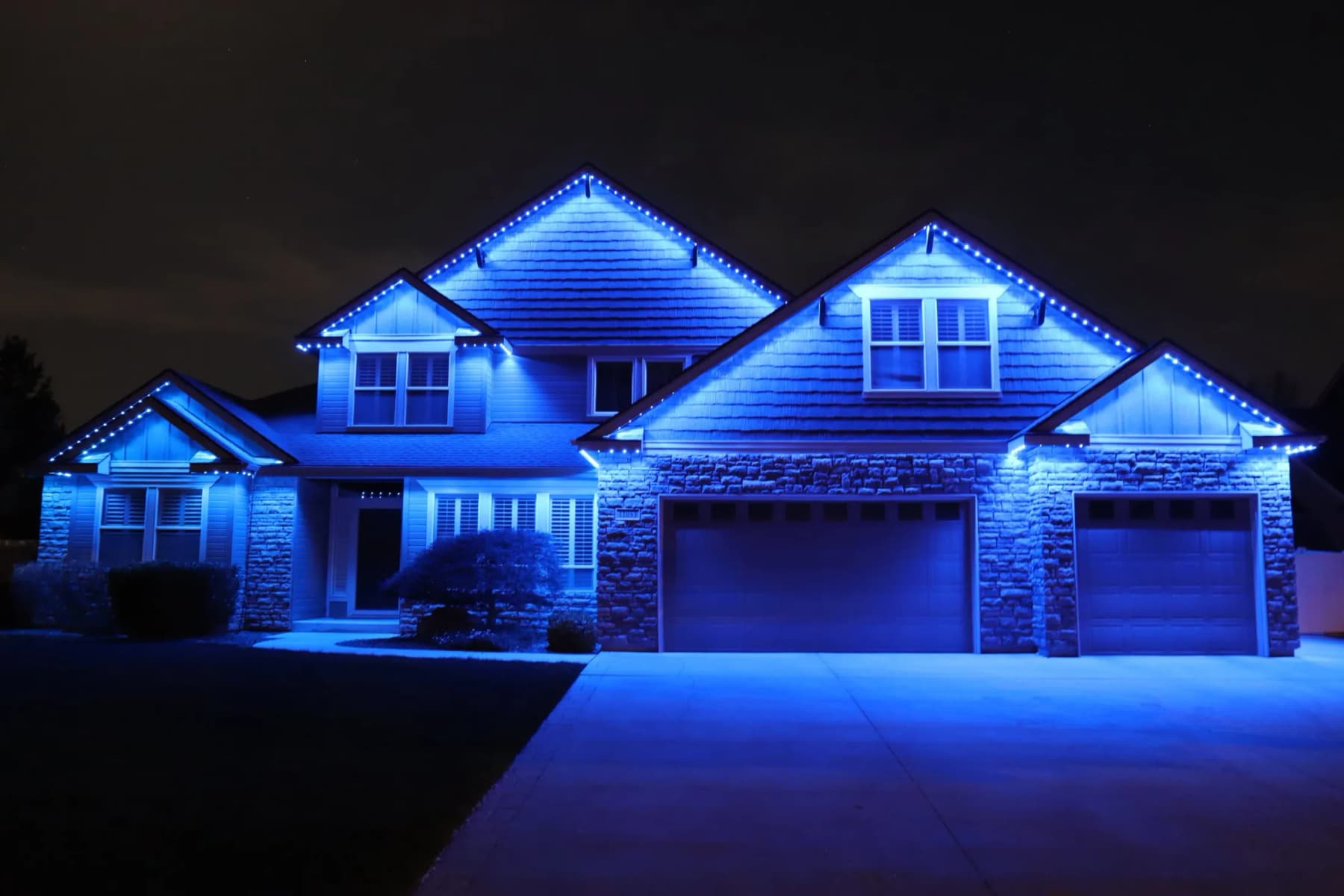
A permanent outdoor lighting system is a run of individually-addressable LED 'pucks' seated inside a slim aluminum channel (the track) that mounts under the soffit or along the roofline of your home. Each puck is typically a 12V RGBW diode - meaning it blends red, green, blue and a dedicated warm-white chip - so it can produce millions of colours plus a genuine, clean white. A low-voltage power supply feeds the run, and a small WiFi controller lets you set colours, zones, patterns and schedules.
The whole point is that it stays up all year. Painted to match your soffit, the track nearly disappears in daylight. At night you get architectural down-lighting or full-colour scenes on demand. Because it runs on safe 12V DC and draws a fraction of the power of old incandescent bulbs, you can leave it on nightly without worrying about your hydro bill.
Why Canadian homeowners are switching
- Safety: no annual ladder work in ice and snow - the single most common cause of holiday-season home injuries.
- Year-round use: everyday warm white, holiday colours, game-day team colours, accent lighting for a party - all from one system.
- Curb appeal and resale: clean architectural lighting reads as a premium, permanent feature, not a seasonal add-on.
- Low running cost: modern RGBW LEDs sip power; a typical home's run draws less than a couple of light bulbs' worth of electricity.
- Convenience: schedule dusk-to-dawn, trigger scenes by voice or app, and never touch a staple gun again.
The three tiers of permanent outdoor lighting
Not all 'permanent lights' are the same, and this is where most buyers get burned. There are three genuinely different tiers, and the price differences reflect real differences in durability and control.
Tier 1 - Budget DIY strip lights
These are the flexible silicone LED strips and 'smart rope lights' sold on marketplace sites for a low upfront price. They can look good in the first season, but the diodes are usually 12V, the adhesive backing fails in freeze-thaw cycles, and the controllers are Bluetooth-only with no reliable scheduling. In a Canadian climate they often need replacing within a year or two. Fine for a covered patio; a poor choice for an exposed roofline.
Tier 2 - Consumer-grade track systems
A real step up: rigid pucks in a plastic or thin aluminum track, sold as a branded kit. Better weather resistance and app control, but the trade-offs show up in the details - lower-grade diodes that shift colour over time, plastic tracks that grow brittle in deep cold, thinner power supplies, and warranties that quietly exclude the weather. Serviceable, but rarely the ten-plus-year investment the marketing implies.
Tier 3 - Professional-grade track (what we recommend)
This is what quality installers use and what a serious DIY kit should be built from: sealed 12V RGBW pucks rated IP65 or better, extruded aluminum track in colours that match common soffits, a proper 60-300W power supply sized to the run, a 4-channel WiFi controller with true scheduling, and power-injection and amplifier accessories so long runs stay bright and even from end to end. Backed by a real multi-year warranty. It costs more up front and pays it back in years of trouble-free service.
How to choose the right system
- Weather rating: insist on IP65 or higher on the pucks and connectors - this is non-negotiable in Canada.
- Track material: extruded aluminum, not plastic, and in a colour that matches your soffit (we stock four soffit colours in our parts shop).
- White quality: choose RGBW, not RGB - a dedicated warm-white chip gives a clean everyday white instead of a muddy blend.
- Control: a WiFi 4-channel controller with real scheduling and app zones beats a Bluetooth-only remote every time.
- Power sizing: match the power supply (60-300W) to your total footage, and plan power injection for runs longer than roughly 50-60 ft.
- Warranty and support: a genuine 5-year warranty and a Canadian supplier you can actually reach.
What permanent outdoor lights cost in Canada
Cost is best measured per linear foot of roofline. For a quality professional-grade DIY kit, budget roughly $18-$45 CAD per linear foot depending on run length and accessories - longer kits bring the per-foot price down. A typical single-storey home needs about 100-150 ft; a larger two-storey can run 150-250 ft. Add professional installation and you are generally looking at about $30-$60 CAD per foot installed, which covers labour, ladder work, custom-cutting the track and commissioning the app.
Two ways to save: buy a right-sized Housing Package kit (we offer 50-200 linear-ft kits) rather than piecing every part together at retail, and take advantage of free shipping on orders over $500. If you know exactly what you need, you can also buy individual parts - pucks, track, controllers, power supplies, connectors, injection cables, amplifiers and soffit screws - in our parts shop.
Winter durability - do they survive Canadian winters?
A properly-specified Tier 3 system is built for it. Sealed IP65+ pucks shrug off rain, snow load and ice; aluminum track will not crack in deep cold the way brittle plastic can; and because the pucks sit up inside the soffit channel, they are shielded from direct ice buildup. Low-voltage 12V DC wiring is safe and stable in the cold. The failure stories almost always trace back to Tier 1 or Tier 2 components - budget adhesive strips or plastic tracks - not to properly-installed professional-grade hardware. This is exactly why the tier you choose matters more than the brand name on the box.
DIY vs professional installation
The system itself is designed to be installable by a capable homeowner. If you are comfortable on a ladder, can run a low-voltage wire and use a drill, a weekend is realistic for an average home. Our DIY kits ship with everything pre-matched so you are not guessing at part compatibility, and each kit includes clear instructions.
That said, plenty of people would simply rather not spend a weekend on a ladder two storeys up - and steep rooflines, high peaks or complex soffit lines are genuinely easier for a crew that does this every day. If you are in the London, Woodstock or Kitchener-Waterloo region, we now offer professional installation across Southwestern Ontario, so you can get a flawless finish without touching a ladder.
App and smart control
The WiFi controller is what turns a light strip into a system. A good 4-channel WiFi controller gives you: named zones (front, garage, back), a full colour picker with a true warm white, saved scenes, pattern effects, and - most importantly - real scheduling so the lights come on at dusk and off at bedtime automatically. Look for genuine WiFi rather than Bluetooth-only; WiFi means you can control the lights from anywhere and set-and-forget schedules that actually run without your phone nearby. Most quality controllers also work with common voice assistants.
Where to go next
If you are ready to move forward, the simplest path for most homeowners is a right-sized Housing Package kit from our DIY kits - measure your roofline, round up, and pick the matching 50-200 linear-ft kit. Know exactly which components you need? Build your own bill of materials from individual parts in the shop. And if you are local to Southwestern Ontario and would rather have it done for you, book professional installation and we will handle the measuring, mounting and app setup end to end. Either way, everything we sell is professional-grade Tier 3 hardware, backed by a 5-year warranty, 30-day returns, and free shipping on orders over $500, shipped Canada-wide from London, Ontario.
Frequently asked questions
How long do permanent outdoor LED lights last?
Quality professional-grade LED pucks are typically rated for 50,000+ hours - well over a decade of nightly use. The system as a whole is designed to be a long-term, install-once feature, which is why a real 5-year warranty is a good baseline to look for.
Are permanent outdoor lights expensive to run?
No. They use low-voltage 12V RGBW LEDs that draw very little power - a typical home's full run consumes less electricity than a couple of standard light bulbs, so nightly dusk-to-dawn use has a negligible impact on your hydro bill.
Can I install permanent outdoor lights myself?
Yes. If you are comfortable on a ladder and can run a low-voltage wire, a capable DIYer can install a kit in a weekend. Our DIY kits ship pre-matched with instructions. If you would rather not, professional installation is available across Southwestern Ontario.
Do permanent lights damage my soffit or roof?
Not when installed correctly. The aluminum track fastens up inside the soffit channel with appropriate soffit screws, so the pucks are hidden and protected. There is no adhesive to fail or roof penetration to leak - it is a clean mechanical mount.
How much does a permanent outdoor lighting system cost in Canada?
Plan on roughly $18-$45 CAD per linear foot for a quality DIY kit, or about $30-$60 per foot installed by a professional. A typical single-storey home needs 100-150 ft; a two-storey may need 150-250 ft. Buying a right-sized kit is the most cost-effective route.
What is the difference between RGB and RGBW lights?
RGB mixes red, green and blue to approximate white, which often looks slightly off. RGBW adds a dedicated warm-white chip, so you get a clean, natural everyday white plus the full colour range - the better choice for a system you will use as everyday down-lighting.
Kit or installed
Everything in this guide ships from London, Ontario.
Complete 12V soffit track kits from $1,265, every part sold separately, and professional installation across Southwestern Ontario.
Keep reading
Guides · 8 min
Do Permanent Lights Survive Canadian Winters? A -40 °C Durability Guide
The number-one question Canadian homeowners ask before buying permanent outdoor lighting: will it survive winter? Here is an honest, technical answer covering waterproofing, temperature ratings, snow, ice and why build quality matters more than the sales pitch.
Guides · 7 min
HOA, Condo and Bylaw Rules for Permanent Lights in Ontario
Permanent LED soffit lighting is a low-voltage, unobtrusive fixture, but that does not mean every property is free to install it without checking first. Here is what to look for in condo, HOA and municipal rules before you commit.
Guides · 8 min
Permanent Lighting for Commercial Buildings and Storefronts
Permanent LED soffit lighting is not just a residential upgrade. Storefronts, medical buildings, restaurants and plazas use the same track-and-puck system to hold brand colours year-round with none of the labour cost of seasonal lights.