Guides/Comparisons·8 min read·Updated August 28, 2026
A straight comparison of installing permanent LED soffit lighting yourself versus hiring a pro in Canada — real per-foot costs, time, tools, and the honest trade-offs.
Key takeaways
- 1DIY permanent lighting parts typically run about $9-$12 per linear foot in Canada; professional installation usually lands around $25-$40 per foot installed.
- 2The price gap is almost entirely labour and ladder work — the LED hardware is the same whether you install it or a crew does.
- 3A DIY kit for an average home takes a confident homeowner one to two weekends; a pro crew usually finishes in a day.
- 4Two-storey homes, steep or complex rooflines, and anyone uncomfortable on a ladder are the clearest cases for hiring out.
- 5Buying quality parts protects your warranty either way — a good 5-year LED warranty follows the components, not who mounted them.
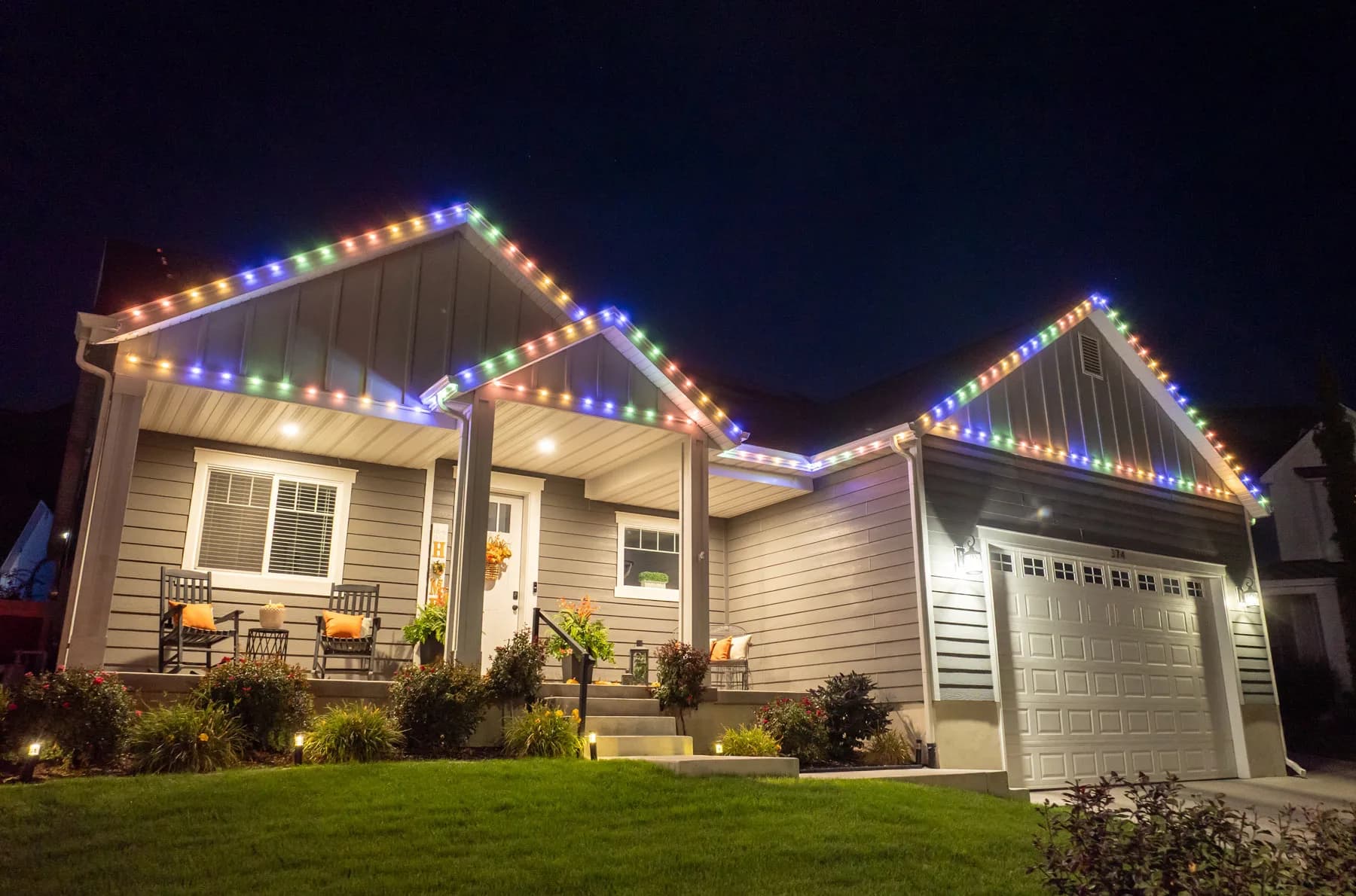
Permanent LED soffit lighting — the low-profile track of colour-changing pucks tucked under your eaves — has two honest paths in Canada: install it yourself from a kit, or hire a crew to do it for you. We sell the DIY kits and the individual parts, and we also install across Southwestern Ontario, so we have no reason to push you one way over the other. This guide lays out the real numbers on both so you can decide based on your house, your comfort on a ladder, and your budget.
The short answer
If you are handy, comfortable working at height, and want to save a meaningful chunk of money, a DIY kit is a genuinely good project. If you have a two-storey home, a complicated roofline, or any hesitation about ladders and heights, professional installation is money well spent. Most people already know which camp they are in before they finish reading the cost table below.
Real cost comparison (Canadian, per linear foot)
Permanent lighting is priced by the linear foot of roofline you want lit. The figures below are defensible market ranges for 2026, in Canadian dollars. Your actual number depends on roofline length, house height, and complexity — but these ranges hold up well across the industry.
- DIY parts (LED track, pucks, controller, power supply, connectors): roughly $9-$12 per linear foot in materials.
- Professional installation (parts plus labour, fully installed): roughly $25-$40 per linear foot.
- Typical DIY kit total for an average single-storey home (about 120-150 ft): around $1,100-$1,800 in parts.
- Typical professionally installed cost for the same home: around $3,000-$5,500 all in.
- Add-ons that move the number: power injection on long runs, extra controllers for very large homes, and premium soffit-matched track colours.
Time: what each path actually costs you
Money is only half the comparison. Your time matters too, and this is where a lot of DIYers underestimate the job.
DIY timeline
A confident, reasonably handy homeowner should budget one to two weekends for an average home. First-timers spend most of that time on the front eaves getting their technique down; the back and sides go much faster once you have the rhythm. Plan for measuring and ordering, one day to run and secure the track and pucks, and a few hours to wire the power supply, set up the WiFi controller, and tune your scenes. Cold Canadian weather adds time — aluminum track and your fingers are both less cooperative near freezing, so a dry day above 5°C makes the whole job easier.
Professional timeline
A trained two-person crew typically completes an average home in a single day, sometimes half a day. They arrive with the right ladders and stabilizers, they have done hundreds of soffits, and they handle the fiddly corners and power injection without a second thought. For most people the real appeal is not just speed — it is never getting on a ladder at all.
Tools and skills you need for DIY
None of this is specialist trade work, but you do need to be comfortable with basic tools and heights. Here is the honest checklist.
- A stable ladder tall enough for your soffit height — and, ideally, a helper to foot it.
- A cordless drill or driver for the soffit screws (a good kit includes matched screws).
- Tin snips or a fine-tooth saw to cut aluminum track to length.
- A tape measure, pencil, and a chalk line for a straight, level run.
- Basic comfort with low-voltage wiring — connecting 12V pucks, a power supply, and connectors. There is no 120V mains wiring in the track itself; the system runs on safe low-voltage DC from a plug-in power supply.
- Patience for the WiFi controller setup and a phone to run the app.
Ladder safety: the real deciding factor
This is the part we will not soften. Falls from ladders are one of the most common serious home-project injuries in Canada, and permanent lighting means working along your entire roofline — moving the ladder dozens of times, often near the peak of a two-storey wall. A single-storey bungalow with low eaves is very approachable for a careful DIYer. A two-storey home, a steep grade around the foundation, or high gable ends is a different job entirely. If you have any doubt about doing that safely, that doubt is your answer: hire it out. No amount of savings is worth a fall.
Warranty: what changes and what does not
A common worry is that installing it yourself voids the warranty. With quality permanent lighting, the manufacturer warranty covers the components — the LED pucks, track, controller, and power supply — for defects, and that coverage follows the parts regardless of who mounts them. Our own 5-year warranty works this way. What DIY does put on you is workmanship: if a puck comes loose because it was not secured properly, that is your install, not a product defect. Professional installation typically adds a workmanship guarantee on top of the product warranty, which is part of what you are paying for. Either way, buying good parts is what protects you — cheap unbranded pucks with no real warranty are the actual risk, not doing the work yourself.
Who should DIY, and who should hire out
DIY is a great fit if you...
- Have a single-storey or low two-storey home with accessible eaves.
- Are comfortable on a ladder and have a helper.
- Enjoy a hands-on weekend project and want to save 50% or more versus installed pricing.
- Live outside our Southwestern Ontario install area — a DIY kit ships Canada-wide.
Hire a pro if you...
- Have a tall two-storey, steep rooflines, or difficult access.
- Are not confident working at height — the single most important factor.
- Would rather have it done in a day with a workmanship guarantee.
- Are in the London, Woodstock, or Kitchener-Waterloo region and want it handled end to end.
Which way should you go?
If you are handy and safe on a ladder, a DIY kit gives you the same permanent lighting the pros install for roughly a third to a half of the installed price — browse our complete kits at /diy-kits, or build your own from individual parts at /shop if you want to match your exact roofline. If your home is tall or ladders are not your thing, and you are anywhere in Southwestern Ontario, let us handle it: book professional installation at /installation and we will take care of the whole job in a day, warranty and all. Whichever path fits your house, you end up with the same clean, year-round lighting under your eaves — and we are happy to help you get there either way.
Frequently asked questions
How much does DIY permanent lighting cost per foot in Canada?
Expect roughly $9-$12 per linear foot in parts for a quality DIY kit — LED track, pucks, controller, power supply, and connectors. For an average single-storey home of about 120-150 feet, that works out to roughly $1,100-$1,800 in materials.
How much does professional permanent lighting installation cost?
Professionally installed permanent lighting in Canada typically runs about $25-$40 per linear foot, all in. For an average home that is usually around $3,000-$5,500. The premium over DIY is labour, ladder work, and a workmanship guarantee — the LED hardware itself is the same.
Is installing permanent lights myself hard?
It is a manageable project if you are handy and comfortable on a ladder. The system is low-voltage 12V DC, so you are not doing mains electrical work — you measure, cut and mount the track, clip in the pucks, and connect a plug-in power supply and WiFi controller. Most people finish an average home in one to two weekends.
Does DIY installation void the warranty?
No. A quality product warranty — like our 5-year coverage — protects the components against defects regardless of who installs them. What DIY puts on you is workmanship. Professional installation adds a workmanship guarantee on top of the product warranty.
How long does permanent lighting take to install?
A DIY homeowner should budget one to two weekends for an average home, more for a large or complex roofline. A professional two-person crew usually completes the same home in a single day.
Should I DIY or hire a pro for a two-storey home?
For most two-storey homes, hire a pro. The work happens along the full roofline near the top of a tall wall, and ladder safety is the single biggest factor. Single-storey homes with accessible eaves are far more DIY-friendly. If you are in Southwestern Ontario, we install; anywhere else in Canada, a DIY kit ships to you.
Kit or installed
Everything in this guide ships from London, Ontario.
Complete 12V soffit track kits from $1,265, every part sold separately, and professional installation across Southwestern Ontario.
Keep reading
Comparisons · 8 min
Permanent Lights vs. Traditional Christmas Lights: An Honest Comparison
A straight comparison of permanent LED soffit track lighting against seasonal string lights and hiring an installer every year — covering real cost over time, safety, convenience, and how each looks day and night.
Guides · 9 min
Permanent Outdoor Lights in Canada: The Complete 2026 Guide
Everything Canadian homeowners need to know about permanent outdoor LED lighting in 2026 - how it works, the three quality tiers, real cost per foot, winter durability, and whether to DIY or hire a pro.
How-to · 9 min
How to Install Permanent Soffit Track Lights (Step-by-Step)
A practical, no-hype DIY guide to installing permanent LED soffit track lights on your own home, from measuring the roofline to pairing the app and saving your first scenes.